
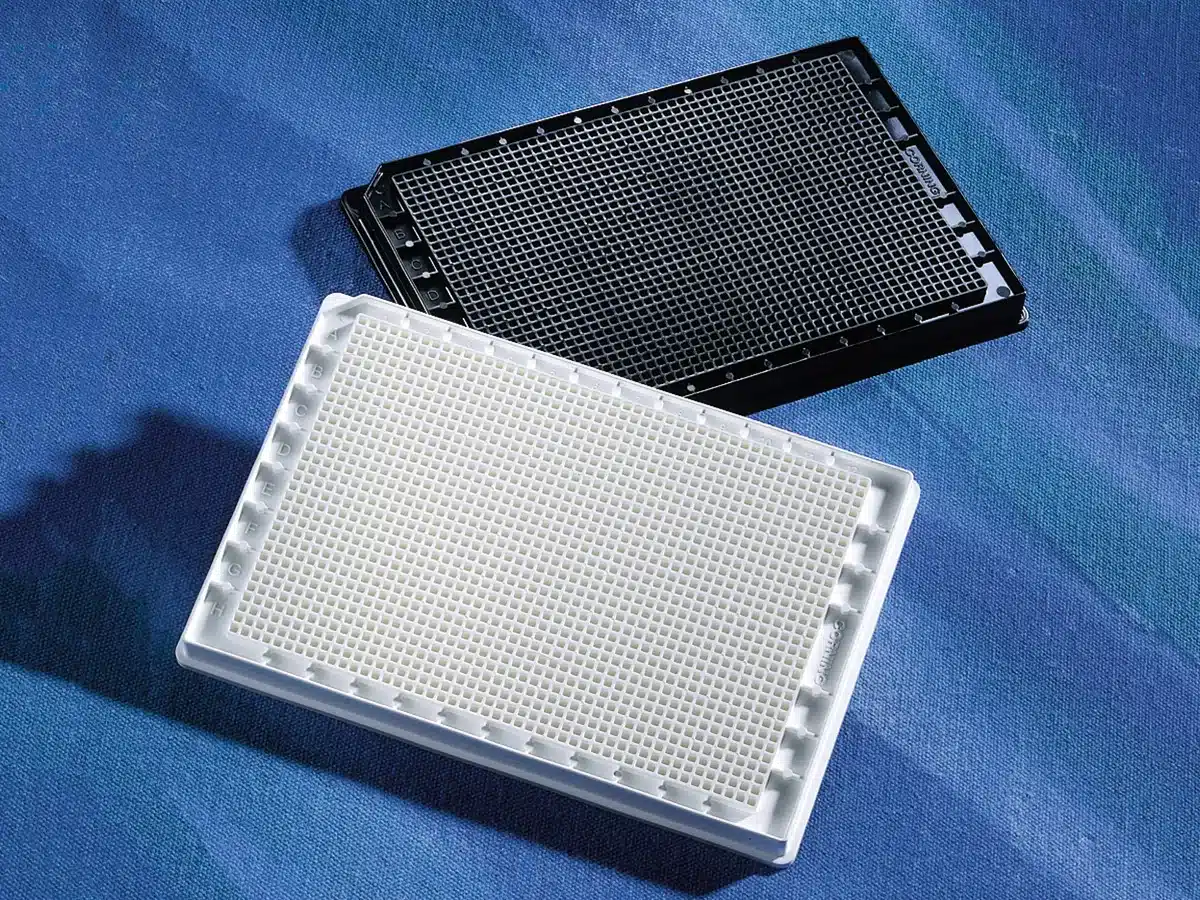
Modern laboratories use higher-density well plates to increase throughput, reduce reagent consumption, and support assay miniaturization. A 384-well plate liquid handler supports accurate dispensing across dense plate layouts, while 1536-well plate workflows place even greater demands on positioning accuracy and repeatability. The Myra liquid handler supports these high-density workflows in a compact benchtop format that accommodates multiple plate types.
Why Labs Need Higher-Density Well Plates
Higher-density well plates increase the number of reactions performed on a single plate while reducing reagent use and saving valuable bench, storage, and incubator space. They also support assay miniaturization without reducing experimental capacity.
An automated liquid handling 384-well workflow allows laboratories to prepare more reactions in fewer runs, making 384-well plates a practical choice for assay setup and reagent distribution.
1536-well plates extend these efficiencies further, supporting highly miniaturized assays that use minimal liquid volumes. Running more reactions on each plate also reduces plate handling across larger studies.
The Challenge Of Manual Pipetting In 384 And 1536 Well Plates
Higher-density plates require smaller transfer volumes and leave less space between wells. Small variations in pipette positioning or dispensing volume become more noticeable as plate density increases.
Manual pipetting also introduces variability during repetitive transfers, making it harder to control missed wells, inconsistent dispensing, splashing, and evaporation across hundreds or thousands of wells.
A 384-well pipetting robot removes much of this manual variability by repeating programmed transfer steps under controlled conditions. Dynamic Retract and MyraSense™ pressure-based sensing work together on Myra to keep precise and accurate pipetting consistent across both 384 and 1536-well workflows. Dynamic Retract detects tip sealing against a well base and retracts before it can pull material into the tip, while MyraSense™ confirms liquid presence and flags issues like air pockets or low-volume wells in real time.
How Automated Liquid Handling Supports High-Density Plate Workflows
Automated liquid handling systems reduce variability by performing identical transfer steps across every well. Stored methods also simplify protocol validation and make repeat experiments easier across different users.
Instead of repeating manual pipetting, automation lets researchers focus on assay design and data analysis while routine dispensing follows the same programmed method each time. Bringing automation into a broader workflow, from sample prep through to data handoff, is where a strategy for lab workflow automation pays off beyond a single plate run.
Myra For 384-Well Plate Liquid Handling
A 384-well plate liquid handler increases throughput while keeping workflows manageable, making it a common choice for assay preparation, reagent distribution, and sample normalization. The format balances higher reaction density with familiar laboratory workflows.
Myra supports 384-well pipetting system workflows with precise low-volume dispensing and straightforward protocol setup. Dynamic Retract minimizes residual liquid left on the pipette tip, while MyraSense’s continuous pressure sensing verifies each aspirating and dispensing step as it occurs. Together, these features improve transfer consistency across repetitive plate setups.
Routine tasks like assay setup and reaction preparation become easier to repeat. Laboratories adopting higher-density plates get the benefits of automation without a large robotic platform or a dedicated automation workspace.
Myra For 1536 Well Plate Liquid Handling
1536-well plates support highly miniaturized assays where positioning accuracy becomes just as important as dispensing accuracy. The smaller well openings leave very little tolerance for alignment errors, particularly during low-volume transfers.
Myra addresses these requirements through high-resolution movement controlled by optical encoders, allowing the pipetting head to align accurately with each target well. Straight 20 µL pipette tips also improve access to closely spaced wells, supporting reliable dispensing across demanding plate layouts.
Myra supports the well plate 1536 liquid handling system workflows by combining precise movement with controlled dispensing, helping laboratories run high-density protocols with confidence.
Plate Format Flexibility Without A Cumbersome Setup
Laboratories rarely use a single plate format throughout every project. Assay development and validation often require different plate types as workflows evolve. Working across multiple formats is easier when the same instrument supports each stage — see the full range of supported applications on the Myra Applications Overview.
Myra’s compact benchtop design supports a range of plate formats without dedicating valuable lab space to a large robotic platform. Laboratories gain flexibility without redesigning the workspace around a single instrument.
Why Myra Is Built For Precise, Repeatable Plate-Based Workflows
High-density plate workflows depend on more than accurate dispensing. Managing larger sample sets also requires reliable sample identification and repeatable protocol execution.
Myra pairs automatic pipetting with software that supports CSV import for larger plate layouts and complex workflows such as cherry picking, so method setup stays straightforward even as plate layouts grow more complex.
The compact benchtop footprint keeps automation accessible for laboratories that want higher throughput without investing in a large automation platform. For teams weighing a 384-well liquid handler or a 1536-well plate liquid handling system, Myra pairs precise dispensing with day-to-day usability that fits an existing bench, not just a spec sheet.

Choosing A Liquid Handler For 384 And 1536 Well Plate Workflows
Selecting a 384-well plate liquid handler involves more than comparing transfer speeds. Laboratories should evaluate dispensing accuracy, supported plate formats, protocol repeatability, and the instrument’s footprint within the laboratory.
Software usability also affects day-to-day operation. Protocol storage, CSV import, and straightforward method setup all simplify protocol management for larger studies.
Myra brings these capabilities together in a compact platform that supports both 384 and 1536-well workflows.
See how Myra handles your 384- and 1536-well workflow. Explore Myra’s applications across molecular biology, genomics, and high-throughput research, or request a demo to see it running on your own protocols.