
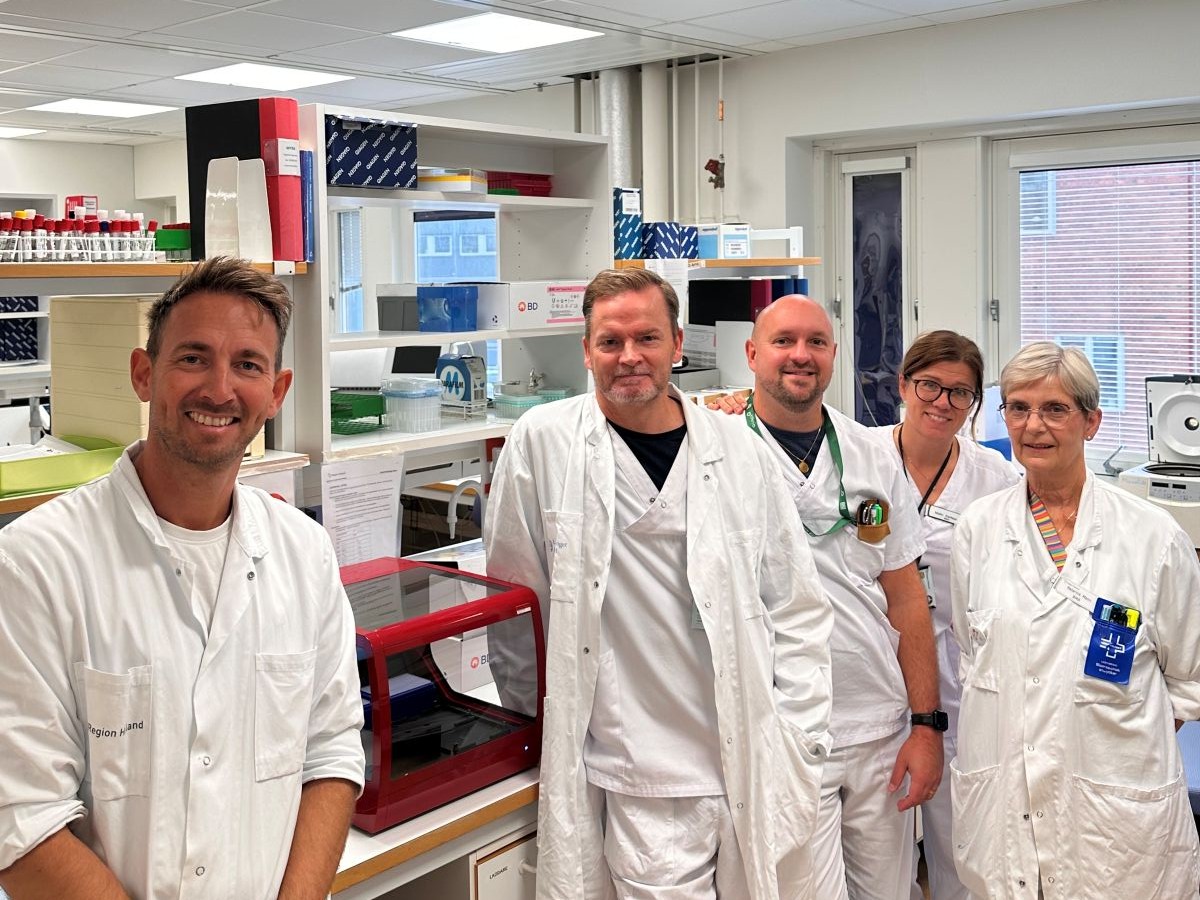
A customer story from Lars-Ola Arvidsson and Chistoffer Lindsten, Molecular Biologists at Clinical Microbiology, Halmstad, Region Halland, Sweden
Region Halland serves around 300,000 people on the west coast of Sweden. Its clinical microbiology laboratory has no dedicated sequencing unit. It also has no rotating specialist team or large sample volumes to spread the workload across.
Instead, six or seven laboratory scientists each manage multiple instruments and assays. At the same time, they face a growing list of diagnostic questions that only sequencing can answer. This combination of genuine diagnostic need and limited laboratory capacity creates a clear challenge. It is exactly the challenge the Myra Liquid Handling System is designed to address.
Halmstad automated Oxford Nanopore Technologies (ONT) 16S and ITS Next Generation Sequencing (NGS) library preparation on Myra. The laboratory also adapted the standard ONT protocol to work reliably with real patient samples. Finally, it assessed the workflow using an eight-sample external QC panel.
A Smaller Lab, a Bigger Sequencing Job
Halmstad’s sequencing programme began during the SARS-CoV-2 pandemic. At the time, the Swedish Public Health Agency secured HERA funding for ten smaller Swedish regions without NGS infrastructure.
Since then, the applications have expanded well beyond COVID-19. The laboratory now uses 16S sequencing for pleural and synovial fluid. It uses ITS sequencing for dermatophytes from skin and nail samples.
It also sequences bacterial isolates that MALDI TOF cannot resolve. In addition, research samples support faecal microbiota transplant (FMT) validation.
However, the challenge is not the science. The challenge is fitting that science into a small team’s daily workload. Every Halmstad scientist manages more instruments and methods in parallel than staff at a larger centre typically would.
Moreover, the laboratory cannot afford wasted sequencing runs. A workflow that relies heavily on individual manual technique creates unnecessary variability. An assay should never become an art. Anyone on the roster should be able to run it and achieve a consistent result.
Automating NGS Library Preparation on Myra
Halmstad’s workflow spans three days. Day one starts with nucleic acid extraction using either EZ2 Connect or magLEAD, depending on sample type.
Next, the Myra Liquid Handling System performs NGS library preparation. The workflow uses Oxford Nanopore Technologies’ Microbial Amplicon Barcoding Kit 24 V14 (SQK-MAB114.24).
Days two and three cover MinION sequencing and downstream analysis in CLC Genomics Workbench. Finally, the laboratory transfers results to its laboratory information system (LIS).
Myra takes over the most pipetting-intensive stage of the workflow: NGS library preparation. At this stage, consistency is critical. Automating the process reduces the potential for pipetting variability.
Meanwhile, the operator can focus on other instruments and laboratory tasks. NGS library preparation on the Myra Liquid Handling System requires roughly 20 minutes of hands-on operator time. This covers PCR setup through to loading the sequencer.
Once the run starts, the process continues unattended. As a result, scientists can spend that time on other instruments, assays and patients.
Automation also provides another benefit in a regulated diagnostic environment: complete traceability of barcode assignments to samples. The workflow records every sample and barcode pairing. Therefore, staff have a clear audit trail for resolving potential mix-ups quickly and avoiding unnecessary repeat testing.

Figure 1. The Halmstad microbial sequencing workflow, from nucleic acid extraction through to sequencing and analysis.
Adapting the ONT Protocol for Clinical Samples
Clean reference isolates differ from real patient material. Therefore, Halmstad made several deliberate changes to the standard Microbial Amplicon Barcoding Kit 24 V14 protocol.
80% Ethanol Instead of Small Fragment Buffer
SFB did not provide enough clean-up for the more challenging synovial fluid samples. Residual material caused rapid blockage of flow cell nanopores during sequencing.
Therefore, Halmstad now uses 80% ethanol across all sample types. This change solves the problem while keeping the protocol consistent.
BSA Added to Clinical 16S Samples
After eluting 200 µl of extract, Halmstad adds 2.5 µl of BSA before amplifying clinical samples. However, BSA is omitted for colony isolates, as the DNA is already clean and does not present the same level of inhibition.
35 PCR Cycles Instead of 25
The kit’s validation data uses clean, high-quality isolate DNA. In contrast, clinical samples often have low yields or degraded DNA. Therefore, the additional cycles help compensate for these limitations. They also improve amplification from real-world clinical material.
None of these changes is substantial. However, each reflects the practical difference between controlled validation and routine testing with variable patient samples.
External QC Results: From Sample to Species
To assess the automated workflow, Halmstad ran an eight-sample external QC panel. It included strong positive, weak positive, multiple positive and negative samples.
The laboratory uses a synthetic spike as an internal control. This helps estimate detected organism concentrations and distinguish significant findings from background contamination.
The results showed clear separation between the positive and negative controls. Samples S4 and S7 returned only tens of classified reads. Halmstad correctly identified both as negative.
In contrast, the remaining samples produced substantially more classified reads. The positive controls also showed clear dominant species. These included Staphylococcus aureus, Klebsiella pneumoniae and Acinetobacter species.
For 16S and ITS sequencing, Halmstad generally aims for approximately 1,000 reads per sample. However, stronger samples can accumulate considerably more reads. Meanwhile, weaker samples can continue building sufficient coverage.
The laboratory uses a minimum Q score of 10 as its quality threshold. It has also recovered useful results from samples with substantially fewer reads.

Figure 2. 16S read yield and taxonomic identification across an eight-sample external QC panel.
Species-Level Identification and ITS Limitations
For Halmstad, the workflow provides value beyond bacterial identification. 16S sequencing routinely provides species-level identification for bacteria.
Meanwhile, ITS sequencing provides species-level identification for most fungi, including Trichophyton and, in most cases, Aspergillus.
However, ITS alone cannot reliably distinguish some closely related Aspergillus and Fusarium species. Therefore, the laboratory may report these organisms only to genus level. This limitation comes from the marker rather than the sequencing workflow. Previously, Halmstad addressed these cases using additional Beta Tubulin 2 and TEF1 targets.
However, the current SQK-MAB114.24 kit does not support these targets. The laboratory therefore recognises this as a current limitation of the approach.
Bioinformatics Built Around Clinical Reality
Halmstad analyses sequencing data using several workflows within CLC Genomics Workbench. For 16S taxonomic profiling, it uses the TRANA database with its internal synthetic spike.
For ITS, the laboratory uses the UNITE database at 99%. It also uses additional NCBI reference sequences for Aspergillus, Trichophyton and Fusarium.
When taxonomic profiling produces an ambiguous result, Halmstad can generate a consensus FASTA sequence. It then uses a representative member of the suggested genus as a reference.
Next, the laboratory compares the result against NCBI. Finally, it adds confirmed species to its laboratory database.
This local approach is important in a decentralised setting. Swedish regulations restrict sharing patient data between regional hospitals. Therefore, Halmstad currently performs its own bioinformatics.
Meanwhile, the laboratory compares its workflows with results from the national 1928 platform. A longer-term national bioinformatics platform is also being developed.
Combining 16S and ITS on One Flow Cell
Using one automated NGS library preparation workflow for both 16S and ITS gives Halmstad greater flexibility. For example, the laboratory can combine samples from different applications in a single MinION run. It does not need to wait for enough samples from one application to fill a flow cell.
In one combined 16S and ITS run, Halmstad multiplexed 24 barcodes. The run generated approximately 3.6 Gb of sequencing data, with an N50 of 1,554 bp. This provided substantially more sequencing depth than either application required individually.
For a laboratory processing only five to ten samples each week, this flexibility is particularly valuable. Halmstad can combine whichever samples are ready across different applications. As a result, it uses available sequencing capacity more efficiently without needing the sample volumes of a larger centre.

Table 1. N50 is a standard measure of read length, where half of the sequenced DNA came from reads at least this long. A higher N50 generally means longer, more informative reads.
Making Sequencing Practical for a Smaller Laboratory
For a smaller clinical laboratory, the question is not simply whether a sequencing method works. The laboratory must also maintain the expertise, time and resources required to run it routinely.
At Halmstad, staff require thorough training before receiving a licence to perform a method independently. The laboratory renews these licences every two to three years. However, maintaining competency becomes harder when a workflow runs only every few weeks. This is especially true when it takes two to three days and involves many steps and reagents.
The same staff also manage numerous other instruments and methods. Automation changes that equation. By taking over the most elaborate and error-prone pipetting steps, the Myra liquid handler makes the workflow easier to teach. It also makes the workflow more consistent to perform.
In addition, automation reduces opportunities for variation in reagent volumes and barcode assignments. As a result, the workflow depends less on frequent hands-on experience with every protocol step.
As Lars-Ola Arvidsson explains:
“The simplicity of it opens doors to implementing sequencing methods that would otherwise require specialist training. In a clinical diagnostics setting with all its high-quality standards, it is not possible to maintain competent staff on methods that border on an artform when done completely manually, particularly in smaller hospitals where staff work in parallel with numerous instruments and methods.”
The benefit extends beyond training. Halmstad processes only five to ten samples in a typical sequencing run. Therefore, it does not have the throughput of a large sequencing centre. A simple, flexible and economical workflow is essential for making sequencing practical within the existing laboratory environment.
The laboratory also values the ability to trace exactly which barcode was assigned to each sample. If uncertainty arises, the automated workflow lets staff backtrack the sample and barcode pairing.
The Takeaway: Decentralised Microbial Sequencing in Routine Practice
Halmstad’s experience shows that smaller clinical microbiology laboratories can incorporate decentralised microbial sequencing into routine workflows. They do not necessarily need a dedicated sequencing unit or large specialist team.
The external QC panel identified the expected positive and negative controls. Meanwhile, the combined 16S and ITS run showed that different applications can share sequencing capacity within one workflow.
The laboratory also adapted the standard Oxford Nanopore Technologies’ Microbial Amplicon Barcoding Kit 24 V14 protocol for variable clinical samples. These changes highlight the importance of designing workflows around routine samples rather than idealised validation material.
For a laboratory processing only a handful of samples every few weeks, automation offers benefits beyond pipetting. It reduces hands-on time and simplifies training. It also supports consistent execution and helps integrate sequencing into an already busy clinical laboratory.
The value of that automation is perhaps best captured by Lars-Ola Arvidsson’s observation:
“Without automation, maintaining sequencing competence within your lab is going to be much more expensive than the investment.”
For Halmstad, the Myra Liquid Handling System has helped make microbial sequencing a practical part of routine laboratory operations.
Bio Molecular Systems thanks Lars-Ola Arvidsson, Chistoffer Lindsten and the Clinical Microbiology team at Region Halland. We thank them for sharing their workflow, data and perspective for this article.