
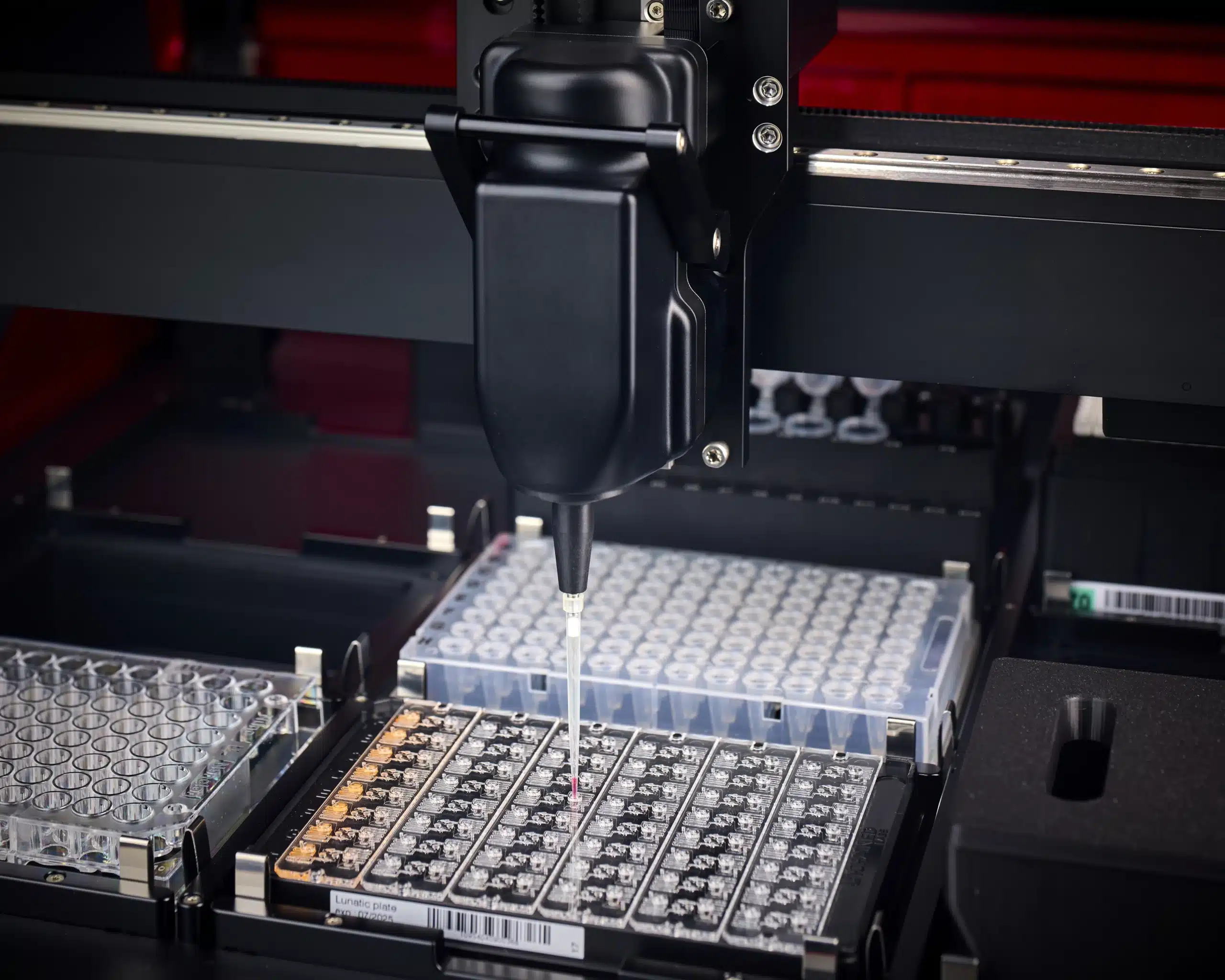
Liquid handling is a fundamental part of many laboratory workflows, supporting everything from sample preparation and assay setup to PCR preparation, reagent dispensing, and next-generation sequencing (NGS). However, these processes often involve repetitive liquid transfer steps that can be time-consuming and difficult to scale when performed manually.
As laboratories face increasing pressure to improve efficiency while maintaining accuracy and reproducibility, many are turning to automated liquid handling systems. By automating routine pipetting and sample transfer tasks, laboratories can reduce manual workload and streamline day-to-day operations.
In this guide, we will cover the benefits of automated liquid handling in a laboratory and what you need to know before setting up an automated liquid handler.
Related Article: What is Laboratory Automation
What Is Automated Liquid Handling?
Automated liquid handling uses robotic technology to perform liquid-transfer tasks that researchers and lab technicians would otherwise carry out by hand.
These systems use programmed workflows to transfer precise volumes of liquids between tubes, plates, and other labware, helping to reduce variability and improve consistency across experiments. Depending on the application, automated liquid handling can support simple sample transfers as well as complex, multi-step workflows involving hundreds or thousands of individual liquid handling steps. Defined protocols enable them to carry out liquid transfer steps on multiple samples consistently and minimize the variability that might arise from manual handling.
By automating repetitive liquid handling tasks, laboratories can improve workflow and reduce manual workload while ensuring that samples and reagents are handled accurately every time. This makes automated liquid handling a valuable tool for laboratories looking to increase productivity.
What Is An Automated Liquid Handler?
An automated liquid handler is a machine designed to accurately and consistently perform liquid handling tasks with minimal manual intervention. These systems automate routine processes such as pipetting, dispensing, mixing, aliquoting, reaction preparation, and transferring liquids between tubes, dishes, and plates, helping laboratories improve efficiency across workflows.
By following predefined protocols, automated liquid handlers can perform liquid transfer steps consistently across multiple samples, reducing the variability that might otherwise occur with manual handling.
These systems are available in a variety of sizes and configurations to suit different laboratory requirements. A compact benchtop automated liquid handler is designed for smaller laboratories or specific workflows, while a high-throughput platform is capable of processing large sample volumes and supporting more complex applications.
Why Laboratories Automate Liquid Handling
In many laboratories, there is a growing interest in automated liquid handling because of the challenges associated with performing repetitive liquid handling tasks manually. While liquid handling activities are essential to day-to-day laboratory operations, they can also be time-consuming and difficult to scale as workloads increase. As sample volumes grow and protocols become more complex, laboratory staff may spend a significant amount of time performing routine manual pipetting and liquid handling. This can limit productivity and reduce the time available for other important tasks.
Laboratories also use automation to improve consistency. Even highly skilled researchers can introduce small variations when performing repetitive tasks, particularly across a large number of samples. Automated liquid handling systems can help standardize processes, ensuring that liquid transfers are performed consistently from run to run and between different operators.
Increasing sample throughput is another consideration. As demand grows, laboratories need to process more samples without proportionally increasing staffing levels or working hours. Automation helps support this growth by enabling reliable, repeatable workflows that can operate efficiently at larger scales.
How To Automate Liquid Handling In A Laboratory
To successfully automate liquid handling, you must think about your laboratory’s existing workflows, challenges, throughput demands, and applications.
By evaluating current workflows and defining clear goals, you can determine which processes are best suited for automation.
Here is a practical framework for introducing automated liquid handling into your laboratory.
Identify The Workflows You Want To Improve
The first step in automating liquid handling is to identify the workflows that would benefit most from it. Labs often start by reviewing routine processes that they perform manually, which are repetitive, time-consuming, or prone to variability. These typically include assay setup, PCR preparation, reagent dispensing, serial dilutions, sample normalization, and NGS library preparation. By understanding where bottlenecks or inconsistencies occur, you can prioritize where automation is likely to have the greatest impact.
Understand Your Sample Volumes And Throughput Needs
Before selecting an automated liquid handling solution, you should evaluate your current and future workload requirements. Consider factors such as the number of samples processed per day, week, or month, and the complexity of your protocols. Also, are demands expected to grow over time? Understanding these requirements helps ensure that any automation solution is appropriately sized for your laboratory’s needs and capable of supporting future expansion without creating unnecessary complexity.
Choose A System That Fits Your Laboratory
Automated liquid handling systems are available in different sizes and configurations, such as compact benchtop instruments and larger high-throughput platforms. When evaluating options, consider factors such as available bench space, workflow requirements, sample volumes, labware compatibility, ease of use, and integration with existing equipment.
Standardize Protocols Before Automating
Automation is most effective when workflows are already well understood and consistently performed. Before implementing an automated liquid handling system, it is helpful to review and standardize your existing protocols to ensure procedures are clearly defined and reproducible. This includes verifying liquid handling steps, reagent volumes, workflow sequences, and quality control measures. Standardizing processes before automation makes implementation easier, and results are more reliable when workflows are moved over to an automated platform.
Train Users And Review Performance
Proper training of your laboratory staff helps them understand system operation, workflow setup, maintenance requirements, and best practices. If you have already implemented automation, periodically assess training and performance to ensure that workflows continue to perform as expected. Continuous evaluation can also help to uncover areas for additional optimization as your laboratory requirements change.
Benefits Of Automated Liquid Handling
Automated liquid handling has several benefits for laboratories wishing to improve efficiency and output by eliminating variation and supporting more reproducible results.
Whether used for routine sample preparation or more complex molecular biology workflows, an automated liquid handling system is now essential for labs to work more efficiently and with greater confidence in their results.
These advantages are why automated liquid handling has become an increasingly valuable tool in modern life science laboratories.
Improved Consistency
Laboratory workflows tend to rely on repetitive tasks such as pipetting, reagent dispensing, sample transfers, and reaction setup, where even small variations can affect results. While skilled laboratory staff work hard to maintain accuracy, manual processes can naturally introduce differences between users, runs, and experiments.
Automated liquid handling systems usually standardize these steps by following predefined protocols to perform liquid transfers consistently. Automation can help increase consistency, improving reproducibility and confidence in experimental data. This is especially relevant for use cases where accuracy and repeatability are key to producing reliable results.
Reduced Manual Workload
One of the major benefits of automated liquid handling is the reduction of the manual workload for repetitive laboratory tasks. These processes can require significant hands-on time, particularly when working with large sample numbers or complex workflows.
This shift not only improves laboratory efficiency but also helps organizations make better use of their scientific expertise. Rather than spending hours on repetitive manual pipetting tasks, researchers can use automation to focus on higher-value work and activities that drive innovation, support decision-making, and contribute to scientific progress.
Better Workflow Efficiency
Laboratories can take advantage of automated liquid handling to streamline the execution of workflows. Automation systems can reliably perform predetermined protocols, allowing for efficient daily sample batch processing, repetitive assay runs, or reaction preparation for molecular biology applications, while maintaining accuracy and reproducibility.
Support For Scaling Workflows
As laboratories grow, they often find that they have to deal with increased sample numbers. Keeping up with this extra demand using manual processes can require more staff time and resources to maintain productivity.
By automating liquid handling, laboratories can scale their workflows more efficiently, providing consistent, efficient liquid handling regardless of sample volume. Automation supports reliable workflow execution while reducing pressure on laboratory personnel as throughput increases. It offers a pragmatic approach to demand management without compromising accuracy and workflow reliability.
Start Automating Liquid Handling With Myra
You can clearly see how liquid handling automation plays a crucial role in helping modern laboratories improve consistency across samples and experiments, including reducing repetitive manual work, avoiding variability caused by differences in execution, and building more reliable workflows.
By automating routine tasks such as pipetting, reagent dispensing, sample transfers, and reaction setup, laboratories can support reproducible results while allowing scientists to spend more time on research, analysis, and other high-value activities.
Ready to see the Myra automated liquid handler in action? Book a demo today.
Alternatively, if you have any questions or would like to discuss your requirements, contact us directly.