
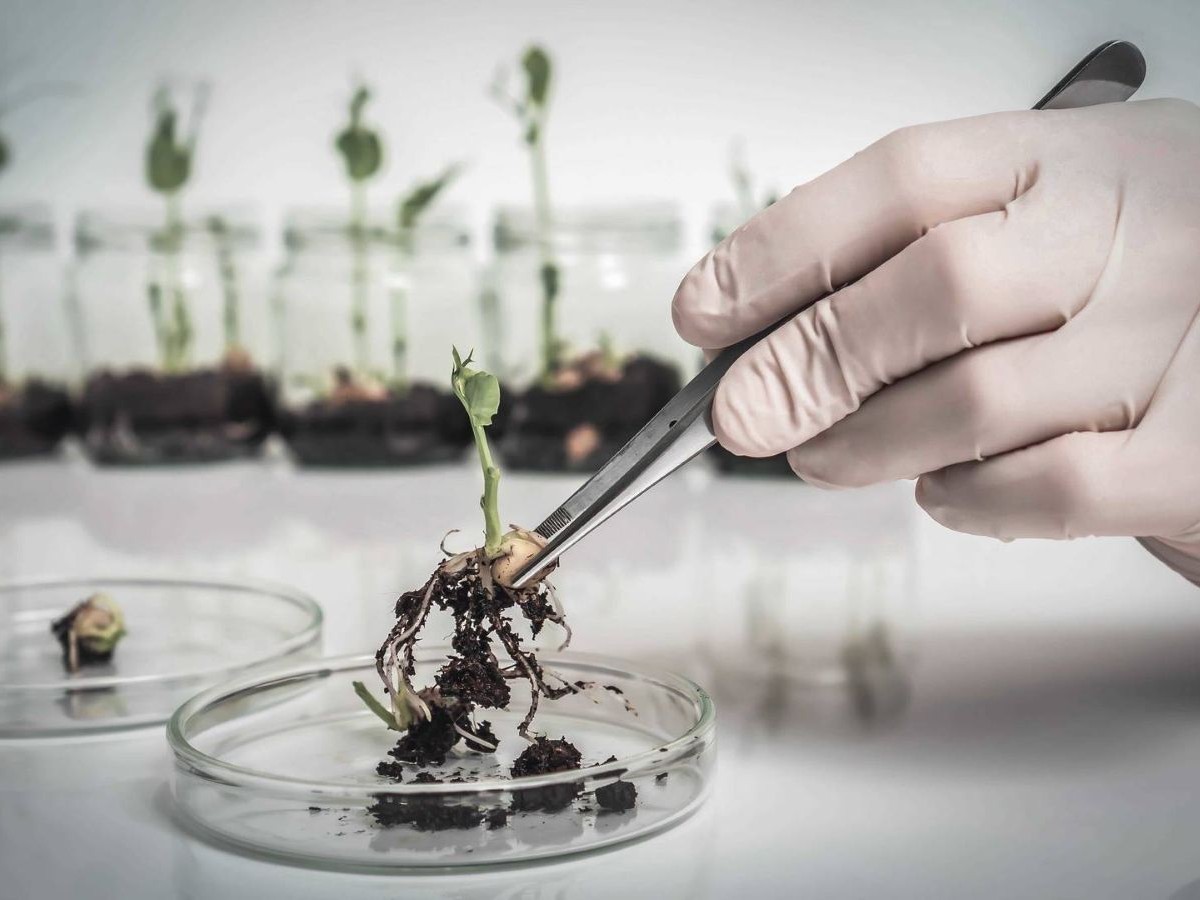
A study by Magtivio B.V, Nuth, The Netherlands.
In plant biology, DNA yields post extraction move around for two reasons. Only one of them is yours to fix. Magtivio automated the magnetic bead clean-up step on Myra across six seed types and measured yield, purity, qPCR performance and DNA size. Here is what the results show, and what they cover.
Two Reasons Your Plant DNA Yields Differ After DNA Extraction
Ask two people why their plant DNA yields jump about and you get two answers.
The first is the seed. Wheat grain and tomato seed are not the same problem. Seeds differ in oil, starch, polysaccharides and polyphenols, the sugars and plant compounds packed in alongside the DNA, and they give up plant genomic DNA at different rates under the same conditions. Size and ripeness move the DNA yield too, even within one species.
The second is the handling during the extraction workflow. Bead volumes judged by eye. Wash steps timed by feel. Liquid drawn off a magnet block with more care on some wells than others. Elution volumes that drift by a microlitre or two between people.
Both show up the same way. A spread of DNA yields across a plate does not tell you which one caused it. That is the real problem. Plant DNA prep varies, and some of that you cannot avoid. What hurts is not knowing which part is which.
Mixed-up Causes Carry Forward
If you cannot tell the two apart, you carry both into the downstream steps.
In work that quantifies things, the amount of DNA you put in shapes the answer you get out. Seed lot testing, GMO checks, variety identity and copy number work all rest on knowing that a difference came from the sample and not the sample prep.
In sequencing, uneven input makes uneven libraries. Uneven libraries make uneven coverage once you pool them, and no amount of DNA normalisation afterwards fully rescues that.
And when something fails, mixed-up causes cost you time. A plant extract that will not amplify might carry PCR inhibitors, or be under-lysed, or be badly pipetted, or just be a seed with little DNA in it. You cannot rule out the method while the method keeps moving.
Take the variability in liquid handling out and the seed is the only thing left to explain.
Methodology - Where the Myra Automated Liquid Handler Picks Up the Work
Plant labs have a few ways to get DNA out of a seed. CTAB extraction is the old standby but it is slow. Silica spin-column extraction is quicker but caps out at a few dozen samples before the centrifuge steps become the bottleneck. Direct-PCR lysis skips purification entirely, which is fine until PCR inhibitors decide otherwise. Magnetic bead purification sits in the middle: no columns, no spins between steps, and every liquid movement is something an automated liquid handler can do. That last point is why it automates well. But it helps to say where the automation starts, because it is not at the front.
Seeds have to be broken open first; homogenisation, in method terms. In the Magtivio MagSi-BNS Plant SLS kit study, that meant 4 mm steel beads in a Geno/Grinder, lysis buffer, followed by half an hour at 65°C in a ThermoMixer C, and then clearing by centrifugation at 6000 × g to pellet the debris. All of that was done by hand.
The Myra liquid handling system takes over at the clear lysate and runs the magnetic bead purification from there: bind, wash, elute. That bind–wash–elute magnetic separation is the part with the most repeated pipetting in it, and the part where small differences in technique stack up: draw-offs over the magnet block, wash timing, how much liquid gets left behind each time.
Plant Extraction Workflow with Myra
- Homogenisation — break open the seeds, 4 mm steel beads — Off deck
- Add lysis buffer, 65 °C, 30 min — Off deck
- Clear by centrifugation, 6000 × g, 15 min — Off deck
- Move 100 µL of clear lysate to the deck — Off deck
- Bind DNA to magnetic beads, 5 µL beads — Myra
- Wash, 150 µL — Myra
- Elute, 75 µL elution volume — Myra
- UV-Vis quantification, qPCR, fragment sizing — Off deck
Therefore, this automates the purification, not the whole prep. The hands-on work sits at the front, in the steps that need judgement.
Results - What the Magtivio Study Measured Post Myra Liquid Handling
Magtivio make the MagSi-DNA Plant CLS kit. The MagSi-DNA Plant CLS kit allows fast and cost-effective extraction of DNA from any plant tissue type. CLS stands for Cotyl, Leaf and Seed, which are the most commonly used sample types in Plant Breeding. They ran the kit on a Myra liquid handling system under Workbench v2.0 and published the results as an application note. The figures below are theirs, reported as published.
Repeats on one seed type
They ran 24 matched pepper extractions, two seeds each. Mean DNA yield came out at 42.5 ± 3.6 ng/µL. Against a 75 µL elution volume that equals 3.2 µg of DNA per extraction, and a spread of roughly 8% across the 24 repeats. (Total yield and the 8% figure are worked out from the published mean, spread and elution volume. The Magtivio note gives concentration.)
DNA purity was checked by UV-Vis spectrophotometry on a NanoDrop One, reading A260/280 and A260/230. The second of those matters most for plant work, since it is the one that moves when polysaccharides and polyphenols carry through the clean-up. DNA purity ratios were A260/280 = 2.05 ± 0.7, A260/230 = 1.92 ± 0.4. For plant tissue, that is a tight set of numbers.

Figure 1. Absorbance readings for extracted seeds.
What the 8% covers. These were 24 repeats in one run, on one instrument, with one seed type. The study set out to show what the automated liquid handling method gives across matched samples. Repeat runs on other days, and a side-by-side against manual magnetic bead purification, would tell you different things again, neither was part of this study.
Six seed types
Using one seed per extraction, the study reports seed DNA yield for pepper, tomato, cucumber, rape, sugar beet and wheat. The spread is the interesting part. The best seed type gave about seven times the DNA of the lowest, from the same method.
That is the seed talking. It showed up clearly here because the automated liquid handling combined with the MagSi-DNA Plant CLS kit held steady.
Two things follow for your own bench. A single input volume will not suit every seed type, so a low-yielding species may need more starting material or a smaller elution volume. And if you plan to pool or run extracts from different species together, DNA normalisation is not optional.

Figure 2. DNA extraction from seeds of various species (1 seed per extraction). Concentrations were measured by UV-VIS with the NanoDropTM One (n=4).
Note: The pepper repeat study used two seeds per extraction; the six-species comparison used one. So, the two pepper figures are not meant to line up, and the gap between them tracks the amount of seed that went in.
Will the DNA work in a PCR?
How much DNA you obtained does not tell you whether it will amplify.
Plant extracts are a real risk here. Polysaccharides and polyphenols come through the clean-up alongside the DNA and slow the polymerase down. These are co-purified inhibitors, and they do not show up as a low reading on a spectrophotometer. They show up later, as a reaction that runs late or not at all.
The standard test is a dilution series. If PCR inhibitors are present, watering the sample down helps more than losing template should allow, and the gap between dilutions comes out wrong. A clean reaction moves about 3.3 cycles for every tenfold dilution.
The study ran neat DNA alongside 1:10 and 1:100 dilutions for every seed type, amplifying a tRNA-leucine target by real-time PCR on an Agilent AriaMx. Everything amplified. The authors report no sign of co-purified inhibitors under the conditions they used. This demonstrated the effectiveness of MagSi-DNA Plant CLS kit combined with the Myra liquid handling system.

Figure 3. Real time PCR results from extracted seed DNA with primers targeting the tRNA-leucine gene. The data are presented as mean (n=4), from undiluted, 10 fold diluted or 100 fold diluted samples.
Did the DNA stay intact?
One purified pepper sample went onto an Agilent TapeStation for fragment sizing, using the Genomic DNA ScreenTape assay. Most of the material sat above 60 kb (high molecular weight DNA by any working definition) with no real sign of breakage.
That matters more than it looks. Magnetic bead purification draws liquid up and down many times, and long DNA shears easily. A method that gives you plenty of DNA in short pieces has failed anyone who needs it whole. This one came through.
It is one sample, shown as an example rather than a survey across seed types. Worth reading as a good sign, not a full picture.
What the Myra Results Tell Us
Six seed types, run in one lab, with the kit maker’s own chemistry. It shows what the automated liquid handling purification gives across matched samples, and that the DNA works downstream.
It is one study. Leaf and cotyledon samples were not part of it, though the kit is made for them. And it measures the automated method rather than setting it against manual magnetic bead purification.
Useful, and worth reading for what it is.
One Less Thing to Explain
The point is not that an automated liquid handler does the pipetting.
The point is that when a plant DNA result looks wrong, you have one fewer thing to check. A low yield becomes a question about the seed, or the lysis, or the species. It stops being a question about whether the magnetic bead wash step went the same way this time.
For a lab running plant samples in any number, that makes comparison work possible. You can hold seed lots against each other. You can set the input for each species once and reuse it. And the effort you do spend goes into the front of the workflow, where thinking about the sample actually helps.