
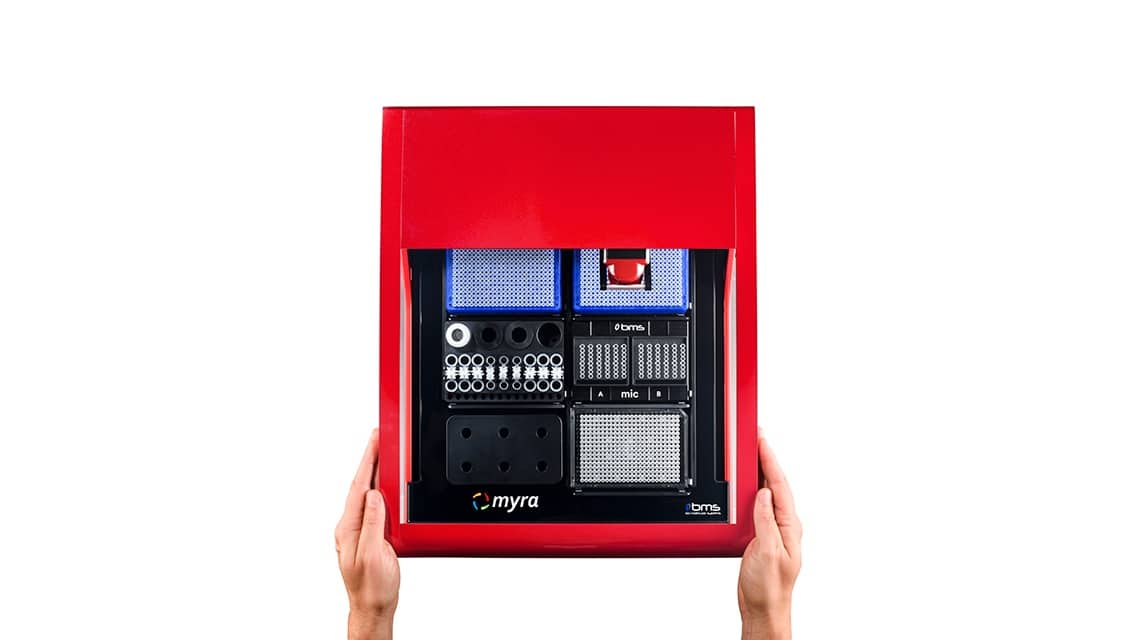
Large liquid handling systems offer extensive automation, but many laboratories never use their full capacity. Instead, they occupy valuable bench space, increase infrastructure requirements, and introduce unnecessary complexity for routine workflows. On the other hand, a compact liquid handling platform like Myra provides automated pipetting in a format that better matches the needsof modern research and diagnostic laboratories.
Now, these labs don’t need to choose between manual pipetting and large automation platforms. Myra delivers repeatable liquid handling in laboratories where automation needs to fit everyday research and diagnostic workflows.
What a Compact Liquid Handling Platform Really Means
A compact liquid handling platform refers to a system that occupies less bench space, weighs less, installs quickly, and integrates into existing laboratory workflows without extensive infrastructure changes. Modern automated liquid handling systems reduce the barriers to automation while maintaining precision and repeatability.
Compact vs Small: Understanding the Difference
A small instrument simply occupies less space. A genuinely compact liquid handler preserves liquid handling capability while reducing footprint, setup complexity and laboratory disruption. A portable liquid handler combines portability with practical laboratory performance instead of reducing functionality.
Why Footprint Matters in Modern Lab Workflows
Many labs operate multiple instruments on the same bench or share equipment across research groups. Every square foot influences how laboratories organize equipment and introduce new instrumentation. A compact instrument leaves room for complementary equipment and supports laboratory expansion without requiring additional workspace.
Watch Myra’s Compact Design In Action With The Flying
Challenges of Large, Cumbersome Liquid Handling Systems
Laboratory automation should simplify daily work. Large liquid handlers add constraints to labs by occupying bench space, extending installation time, and limiting flexibility, which may discourage them from expanding automation further.
Bench Space and Lab Layout Constraints
Larger equipment requires a dedicated bench or even a dedicated room. That commitment reduces flexibility for laboratories operating multiple workflows or sharing equipment across departments. Rearranging existing instruments adds time and interrupts established laboratory processes.
Complex Setup Limits Everyday Use
Many large automation platforms depend on specialist installation, extensive calibration, or ongoing technical support before routine operation begins. Those requirements and costs can delay implementation as workflow priorities change.
How a Compact Design Enables Better Everyday Use
A compact liquid handling platform supports everyday laboratory work by reducing preparation time and simplifying routine operation. Laboratories spend less time accommodating the instrument and more time processing samples, validating results, and advancing research.
Consistent Performance in a Smaller Footprint
Instrument size does not determine liquid handling quality. A well-engineered compact liquid handler like Myra delivers repeatable pipetting performance while occupying significantly less bench space than larger platforms. Researchers achieve consistent liquid transfers across routine laboratory protocols.
Faster, Simpler Integration Into Existing Labs
Many laboratories already operate qPCR instruments alongside other analytical equipment. A compact liquid handling platform fits alongside existing instruments instead of requiring laboratory redesign or dedicated infrastructure. Installation becomes part of routine laboratory planning rather than a major project.
Better Use of Time and Lab Resources
Laboratory workflows depend on efficient movement between preparation, processing, and analysis. A smaller automation platform reduces time spent relocating equipment, managing bench space, or scheduling access to a shared instrument. Laboratory staff spend more time generating data and less time working around the equipment.
Compact Liquid Handling Capability With Myra and Myra9
Myra combines automated liquid handling with a compact footprint for research laboratories, diagnostic facilities, and mobile testing applications.
Myra’s Compact Footprint and Space-Saving Design
Myra occupies less than 2 square feet of bench space and weighs approximately 10 kg, giving laboratories a lightweight, space-efficient platform for automated liquid handling. The instrument moves easily between laboratories, shared facilities, or mobile testing locations while maintaining the precision expected from an automated liquid handling platform.
Fast Setup Without a Technician
Installation does not require specialist support. Myra’s integrated camera supports deck verification, while one-click calibration simplifies setup without manual adjustment. Laboratories are able to introduce automation quickly without lengthy installation or repeated calibration procedures.
Built-In Safety Features That Don’t Add Bulk
Myra incorporates an enclosed pipette-tip waste container, UV LED lights, and a compact HEPA filter to support contamination control during routine workflows.
Myra9 for Labs Needing Extra Deck Space
Some laboratories require additional consumables or parallel workflows. Myra9 expands deck capacity while maintaining the same compact design philosophy, providing additional flexibility without moving to a large automation platform. Laboratories looking to connect liquid handling directly with qPCR cycling can also explore Myra Plus.
Compact Liquid Handling Robots for Space-Limited Labs
Smaller research laboratories, shared facilities, and satellite testing labs still benefit from automation despite limited bench space. Compact liquid handling robots for limited space deliver repeatable pipetting without requiring dedicated work areas. A compact liquid handling robot allows laboratories to expand automation while preserving room for existing equipment.
What to Look for in a Space-Saving Liquid Handling Robot
Evaluate more than physical dimensions. Instrument weight, installation requirements, maintenance needs, and bench compatibility all influence long-term usability. A platform that integrates easily into daily laboratory work delivers greater value than one that simply occupies less space.
Repeatable Protocols for Shared, Multi-User Labs
Shared laboratories rely on standardized workflows to maintain consistent results across multiple operators. Saved protocols reduce variation between users and simplify routine testing, allowing laboratories to reproduce liquid handling workflows without rebuilding methods for every experiment.
See Myra's Compact Liquid Handling Platform Yourself. Book a Demo
Myra delivers automated liquid handling in a compact format that integrates into existing laboratories, supports repeatable results, and scales with changing workflow requirements.
Explore Myra’s applications to see how the platform supports molecular biology, genomics, diagnostics, and research workflows.
Ready to see Myra in your laboratory? Request a demo or submit an enquiry to discuss your workflow requirements with the Bio Molecular Systems team.